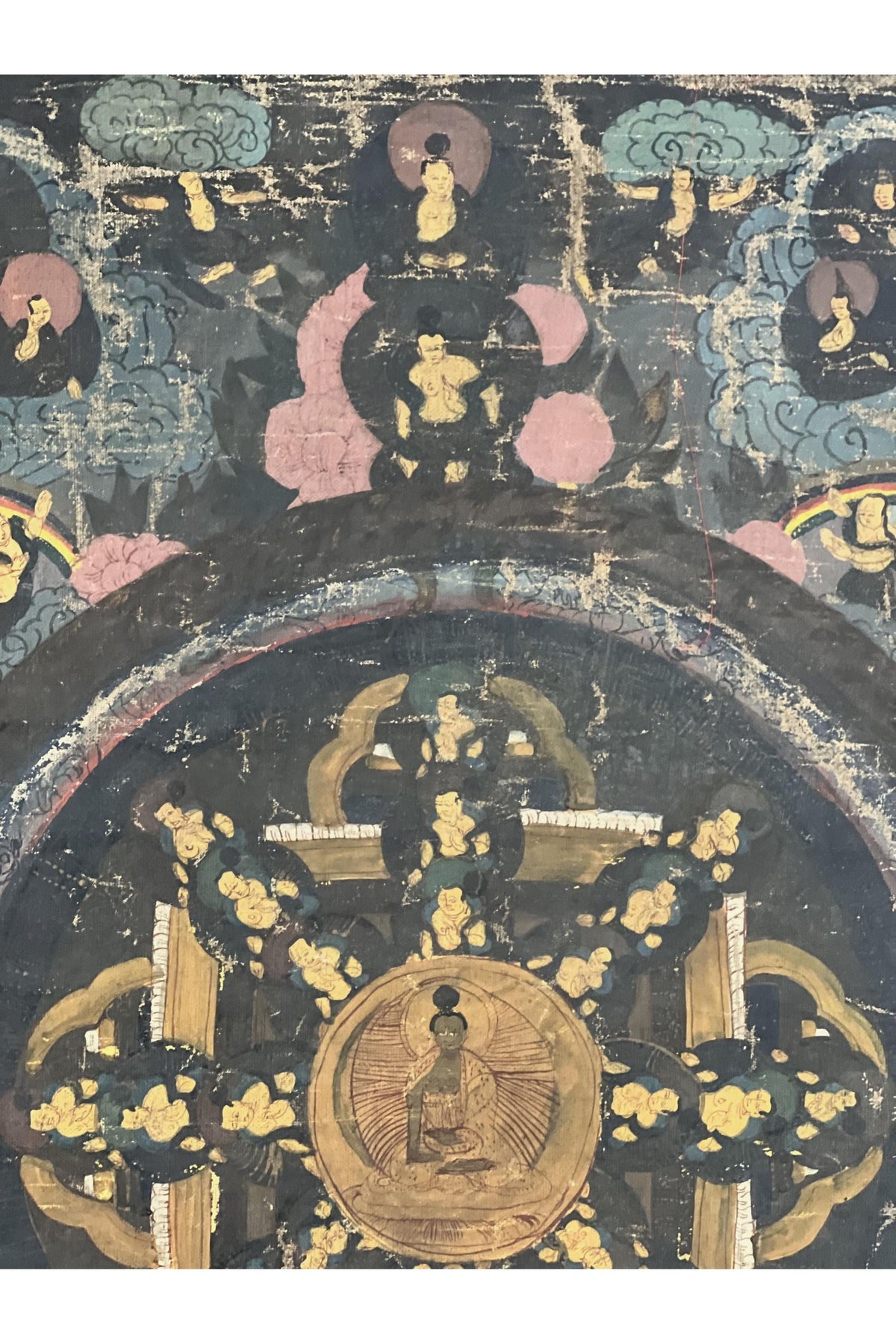
Old Buddha Life Story Mandala | Tibetan Thangka Painting, Meditation Art with Cotton Brocade
Old Buddha Life Story Mandala | Tibetan Thangka Painting, Meditation Art with Cotton Brocade
Couldn't load pickup availability
This original, hand-painted Old Thangka Painting is a testament to the unique craftsmanship of Vajrayana Buddhism. It beautifully captures the essence of the tradition, featuring the Mandala of Buddha's Life Story.
This is a Narrow Border Thangka framed with cotton in a traditional style. A Narrow Border Thangka is a traditional Tibetan Thangka painting framed with a simple, thin fabric border, unlike the more elaborate, expansive brocade commonly seen. Unlike the more intricate and expansive brocade, it is framed with a simple, thin fabric border. The narrow border style highlights the central artwork. The minimalist framing technique highlights the beauty and spiritual significance of the Thangka while preserving the cultural essence of traditional Tibetan art. This type of Thangka is perfect for collectors or practitioners who prefer a more subtle display of their spiritual art.
The "Mandala of Buddha’s Life Story" is a rich and intricate representation that illustrates the critical milestones of Siddhartha Gautama's journey toward enlightenment and eventual Buddhahood. Each section of the Mandala can be seen as a snapshot or symbol of different phases of the Buddha's life, demonstrating the teachings and principles of Buddhism.
1. **Birth**: The Mandala often begins by depicting Siddhartha's birth in Lumbini, Nepal. Surrounded by celestial beings and auspicious symbols, this section signifies the miraculous nature of his entry into the world.
2. **Royal Life**: Next, you may find images portraying Siddhartha's life as a prince, complete with luxuries and indulgences. This contrast highlights his eventual realization of the impermanence of worldly pleasures.
3. **The Four Sights**: This passage depicts a pivotal moment in Siddhartha's life. He encounters an old man, a sick person, a dead body, and an ascetic. These sights deeply affect him and spark his quest to understand suffering.
4. **Renunciation**: This part of the Mandala illustrates Siddhartha leaving his palace and family, symbolizing his commitment to seeking truth and liberation from suffering.
5. **Ascetic Practices**: In his quest, Siddhartha engages in extreme austerities and self-denial, seeking enlightenment through rigorous practices. This section reflects the struggles he faced in this phase of his life.
6. **The Middle Way**: After realizing the limitations of extreme practices, Siddhartha discovers the "Middle Way," a balanced approach to life. This is a critical teaching in Buddhism, emphasizing the avoidance of extremes.
7. **Enlightenment**: One of the mandala's most significant moments is the depiction of Siddhartha meditating under the Bodhi tree, where he reaches enlightenment. This section symbolizes the profound realization of the nature of reality and the cessation of suffering.
8. **Teaching the Dharma**: The Buddha shares his insights with others after his enlightenment. This part often features the First Sermon in Sarnath, where he teaches the Four Noble Truths and the Eightfold Path, laying the foundation for Buddhist teachings.
9. **The Sangha**: The mandala may also include representations of the community of monks and followers that the Buddha established. This aspect emphasizes the importance of community in practicing and spreading the Dharma.
10. **Parinirvana**: Finally, the mandala culminates in depicting the Buddha's death and entry into Parinirvana. This marks the final release from the cycle of birth and rebirth and serves as a reminder of life's impermanence.
The overall design of the mandala often conveys themes of unity, interconnectedness, and the cyclical nature of life, reminding viewers of the path to enlightenment and the importance of compassion and wisdom in overcoming suffering. As such, the Mandala of Buddha's Life Story is a powerful visual tool for reflection and meditation, inviting individuals to explore the deeper meanings of Siddhartha's life and their spiritual journeys.
This Tibetan Thangka radiates spiritual depth and harmony, making it ideal for meditation spaces, yoga studios, or as a profound decorative art piece. It invites peace and positive energy and adds a serene and reflective atmosphere to any space, perfect for those seeking spiritual insight or as a gift for someone practicing Buddhism.
Size With Cotton Brocade: 27-inch x 37-inch (68 x 94 cm)
Size of Inner Painting : 14-inch x 20.5- inch (35.5 cm x 52 cm)
Materials: Hand-painted on cotton canvas with natural pigments
Condition: Vintage, exhibiting significant signs of age.
Origin: Kathmandu Valley, Nepal
Before making a purchase, please take note of the following important information:
- Lighting and screen resolution may cause slight color variations.
- Paintings are more captivating when viewed in person.
- The size mentioned for the painting does not include the outer border.
- Paintings will be securely packed in a PVC tube to ensure safety during transit.
- Buyers are responsible for any additional fees at their destination, including import taxes and duties, which are not included in the purchase price.
Thank you for buying from us!
Share