1
/
de
10
Green Tara Thangka Painting | Shyamatara Hand-Painted Tibetan Buddhist Art | Goddess of Compassion Nepal
Green Tara Thangka Painting | Shyamatara Hand-Painted Tibetan Buddhist Art | Goddess of Compassion Nepal
Prix habituel
$138.99
Prix habituel
Prix promotionnel
$138.99
Prix unitaire
/
par
Frais d'expédition calculés à l'étape de paiement.
Impossible de charger la disponibilité du service de retrait
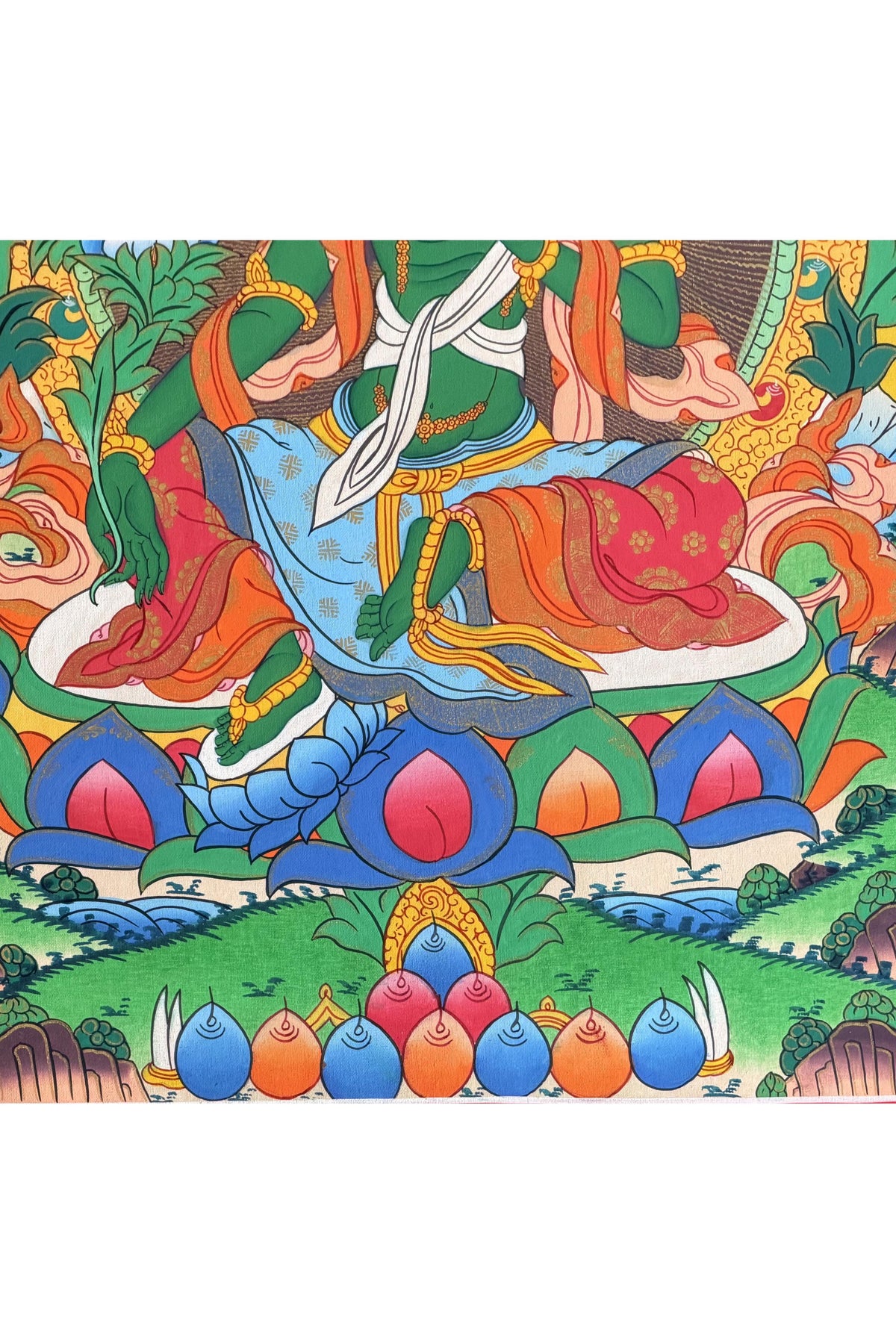
This original hand-painted Green Tara Thangka portrays one of the most beloved and recognizable female figures in Tibetan Buddhism. Known in Sanskrit as Shyamatara, Green Tara embodies active compassion—the compassionate response that does not merely recognize suffering but acts to alleviate it.
Painted entirely by hand in Nepal on handmade cotton canvas, this master-quality Thangka uses natural and traditional stone colors. Tara‘s luminous green form, graceful posture, lotus blossoms, peaceful expression, and finely painted ornaments create a composition that is both visually refined and spiritually meaningful.
Green Tara is peaceful without being passive. Her distinctive posture conveys readiness to respond, making her a powerful representation of compassion expressed through action.
This is an original hand-painted artwork, not a print or digital reproduction.
## Green Tara, the Embodiment of Active Compassion
Tara holds an exceptional place in Mahayana and Vajrayana Buddhism.
Among her many manifestations, Green Tara is among the most widely revered. She is particularly associated with compassion, enlightened activity, fearlessness, and swift assistance to beings experiencing suffering.
Her Sanskrit name Shyamatara refers to her green or dark-green form.
While White Tara is often associated with a serene, contemplative expression of compassion, Green Tara conveys movement and readiness. Her image combines meditative wisdom with compassionate action.
For practitioners, this makes Green Tara a profound reminder that genuine compassion is not simply a feeling—it is expressed through awareness and action.
## The Meaning of Her Green Color
Green Tara‘s distinctive body color is fundamental to her iconography.
Within Tibetan Buddhist symbolism, green is closely associated with enlightened activity and dynamic compassionate action.
Her green form therefore complements the message her posture conveys. She appears serene and fully composed, yet prepared to respond to the needs of sentient beings.
This combination of tranquility and activity is one of Green Tara‘s defining characteristics.
## The Posture of Readiness
Green Tara‘s seated posture contains one of the most beautiful visual teachings within her iconography.
One leg remains folded in a meditative position while the other extends outward from the lotus seat.
The folded leg communicates meditative stability, concentration, and wisdom. The extended leg suggests readiness to rise and respond whenever compassionate activity is required.
Green Tara therefore visually unites contemplation and action.
She is firmly established in awakened awareness while remaining completely available to the world.
## Sacred Hand Gestures
Green Tara‘s right hand is traditionally extended in Varada Mudra, the gesture associated with generosity, giving, and compassionate activity.
Her left hand is raised near her heart while supporting the stem of a lotus flower.
The position of Tara‘s hands, fingers, flowers, body, and other attributes is not simply decorative. Each element belongs to an established visual language that communicates Buddhist teachings and the deity‘s qualities.
Together, these gestures reinforce Green Tara‘s identity as an embodiment of compassionate activity.
## The Lotus and the Meaning of Purity
Lotus blossoms rise gracefully beside Green Tara.
The lotus is among the most enduring symbols in Buddhist art. Growing from muddy water yet opening above its surface unstained, it represents purity and the possibility of awakening within the imperfect conditions of ordinary existence.
This symbolism is particularly appropriate to Tara.
It suggests that wisdom and compassion can emerge amid difficulty without becoming defined or contaminated by it.
The flowers also provide an elegant visual balance around Tara‘s central form, complementing her peaceful expression and graceful posture.
## Green Tara and the Eight Great Fears
Traditional Tara teachings frequently describe her as a liberator from the Eight Great Fears.
These can be understood on more than one level.
Traditional descriptions include external dangers such as lions, elephants, fire, snakes, thieves, imprisonment, floods, and harmful spirits. Buddhist interpretations also relate these dangers to internal afflictions such as pride, ignorance, anger, jealousy, attachment, craving, distorted views, and doubt.
The deeper teaching therefore extends beyond protection from external circumstances.
It encourages practitioners to recognize and transform the internal mental conditions that create fear and suffering.
This dual interpretation gives Green Tara‘s protective symbolism considerable philosophical depth.
## The Mantra of Green Tara
The mantra most closely associated with Green Tara is:
**Om Tare Tuttare Ture Soha**
Within Tara practice, the mantra is recited in connection with her compassionate and liberating activity.
A Green Tara Thangka may therefore serve as a visual support for meditation, visualization, mantra recitation, prayer, and devotional practice.
For collectors who approach the painting primarily as art, the same image provides an opportunity to appreciate the sophisticated visual language through which Himalayan Buddhist traditions have communicated philosophical and contemplative ideas for generations.
## Traditional Himalayan Craftsmanship
This Green Tara Thangka is individually hand-painted on handmade cotton canvas using natural, traditional stone-based colors.
The artist carefully develops Tara‘s facial expression, hands, lotus flowers, jewelry, clothing, throne, halo, and surrounding decorative elements through controlled line work and successive pigment applications.
Master-quality Thangka painting requires patience, disciplined brushwork, carefully established proportions, and close attention to traditional Buddhist iconography.
Artists execute small details with fine brushes, while the composition must remain balanced when viewed as a complete image.
Because this is an individually created artwork, subtle differences in line work, pigments, brushstrokes, and surface texture are natural characteristics of the traditional handmade process.
This is an original painting, not a mechanically reproduced image.
## Product Details
Subject: Green Tara
Sanskrit Name: Shyamatara
Tradition: Tibetan Buddhism, Vajrayana
Primary Association: Compassion and Enlightened Activity
Painting Size: 15 x 20 inches, 38 x 51 cm
Size Note: Measurement excludes the surrounding border
Surface: Handmade cotton canvas
Colors: Natural and traditional stone colors
Binding Medium: Traditional Tibetan glue
Technique: 100% hand-painted
Quality: High / Master Quality
Frame: None
Origin: Hand-painted in Nepal
Condition: Original artwork, not a print
## Suitable For
Green Tara meditation and mantra practice
Buddhist home shrines and altars
Meditation and contemplation rooms
Dharma centers and retreat spaces
Yoga and mindfulness spaces
Collectors of Tara paintings
Collectors of Tibetan Buddhist Thangkas
Himalayan sacred art collections
Meaningful Buddhist and spiritual gifts
## Shipping and Important Information
Free standard international shipping with tracking is included.
We carefully roll the painting and pack it securely in a protective tube for international shipping.
Actual colors may vary slightly because of photography, lighting conditions, and individual screen settings. Natural pigments and detailed brushwork often show greater depth when viewed in person.
Because every Thangka is individually hand-painted, subtle variations in brushwork, pigment application, line work, and surface texture are natural characteristics of traditional craftsmanship.
Import duties, customs fees, VAT, and other destination-country charges, where applicable, are the buyer’s responsibility. Etsy may collect applicable VAT or sales tax directly during checkout for eligible destinations.
Partager