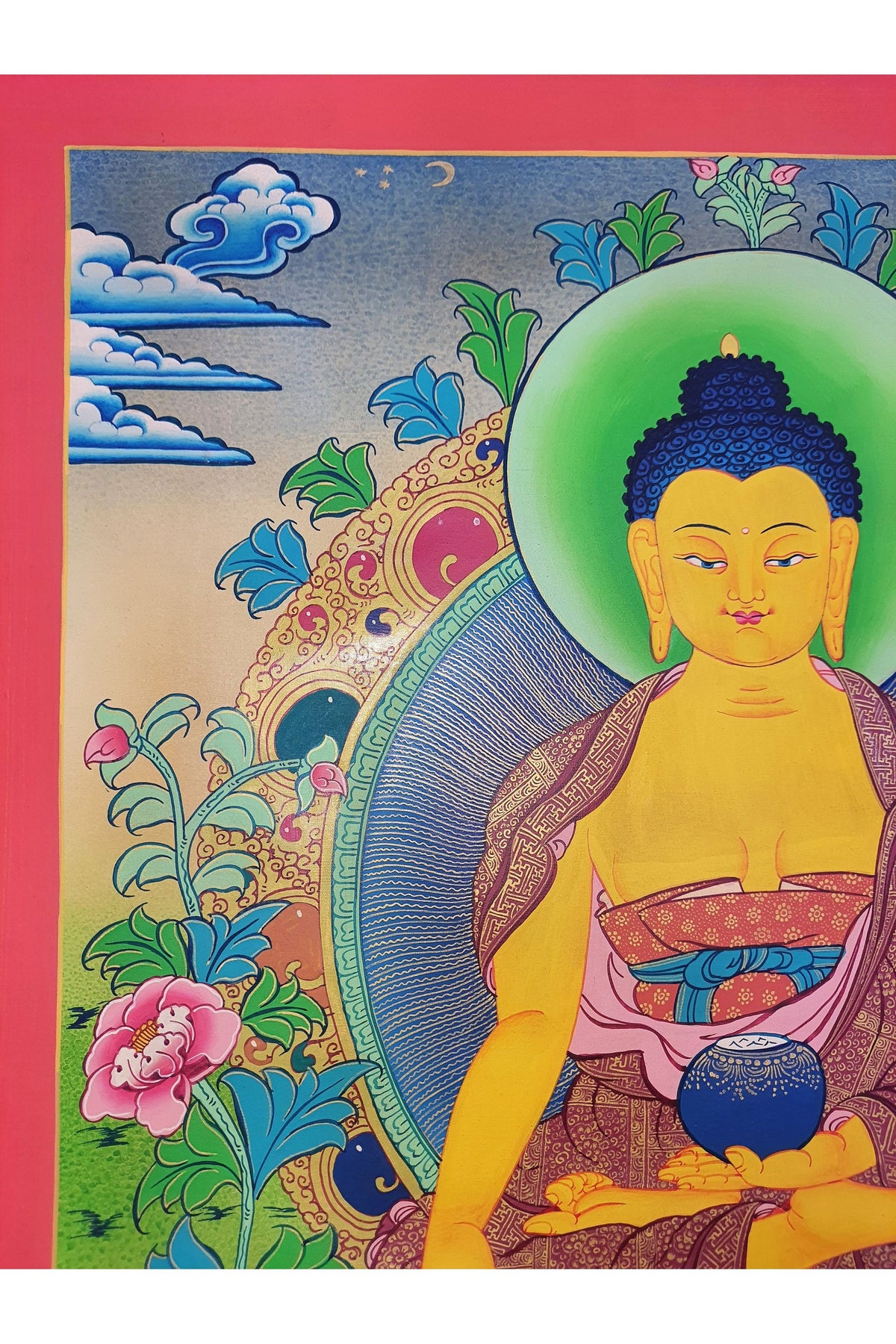
Hand Painted 24K Gold Shakyamuni Buddha Thangka, Smoky Tibetan Art
Hand Painted 24K Gold Shakyamuni Buddha Thangka, Smoky Tibetan Art
Impossible de charger la disponibilité du service de retrait
This is an original hand-painted Masterpiece: a Smokey Gold Shakyamuni/Gautama Buddha Tibetan Thangka painting. Shakyamuni, or Gautama Buddha, is the Buddha of our time and the revered root teacher of all Buddhist lineages.
More About Shakyamuni Buddha
While we often refer to "the Buddha," Buddhism recognizes many Buddhas with unique names, forms, and roles. "Buddha" means "one who woke up," referring to any enlightened individual. It also represents the principle of Buddha-nature. However, the historical Buddha, Shakyamuni Buddha, is the most well-known figure associated with this title.
In Mahayana Buddhism, Shakyamuni refers explicitly to the historical figure Siddhartha Gautama, who became known as Shakyamuni after his enlightenment. Sometimes called Gautama Buddha, this transcendent figure is considered to exist beyond just the historical narrative.
The Historical Buddha
Siddhartha Gautama, later known as Shakyamuni Buddha, was born in Nepal around the 5th or 6th century BCE. Although his existence is historically supported, much of his life is enveloped in legend. As the son of a king, Siddhartha led a sheltered life until, in his late 20s, he encountered sickness, old age, and death. Stricken by these realities, he renounced his royal life to seek inner peace.
After many trials, Siddhartha, around 35, achieved enlightenment through deep meditation under the Bodhi tree in Bodh Gaya, India. Known after that as the Buddha, meaning "one who woke up," he spent his remaining years teaching until his death at about 80 when he achieved Nirvana.
About the Shakya
The name Shakyamuni means "Sage of the Shakya" in Sanskrit. Siddhartha Gautama was born into the Shakya clan, a group that established a city-state in Kapilavatthu, modern-day Nepal, around 700 BCE. The Shakya were thought to be descendants of the ancient Vedic sage Gautama Maharishi. Historical documentation outside Buddhist texts supports the existence of the Shakya clan.
If Siddhartha was the heir to the Shakya throne, his enlightenment might have indirectly led to the clan's downfall. He married and fathered a son, Rahula, who later became his disciple and a celibate monk. According to early scriptures, the Shakya were at war with the Kosala clan, and a peace agreement was attempted through a marriage alliance. However, the Shakya deceived the Kosala by sending an enslaved person instead of a princess. The Kosala prince's son, Vidudabha, avenged this deception by massacring the Shakya and annexing their territory.
This event coincided with the Buddha's death. Stephen Batchelor, in his book Confessions of a Buddhist Atheist, suggests that the Buddha might have been poisoned due to his prominence as a surviving member of the Shakya royal family.
Size of Painting : 18 x 24 Inches (46 cm x 61 cm)
Material: Handmade Cotton Canvas
Color: Tibetan Canvas Cotton, Natural Colors, Stone, Gold Tibetan Hide Glue Mixture, water
Quality: Master
Before making a purchase, please take note of the following important information:
- Lighting and screen resolution may cause slight color variations.
- Paintings are more captivating when viewed in person.
- The size mentioned for the painting does not include the outer border.
- Paintings will be securely packed in a PVC tube to ensure safety during transit.
- Buyers are responsible for any additional fees at their destination, including import taxes and duties, which are not included in the purchase price.
Partager