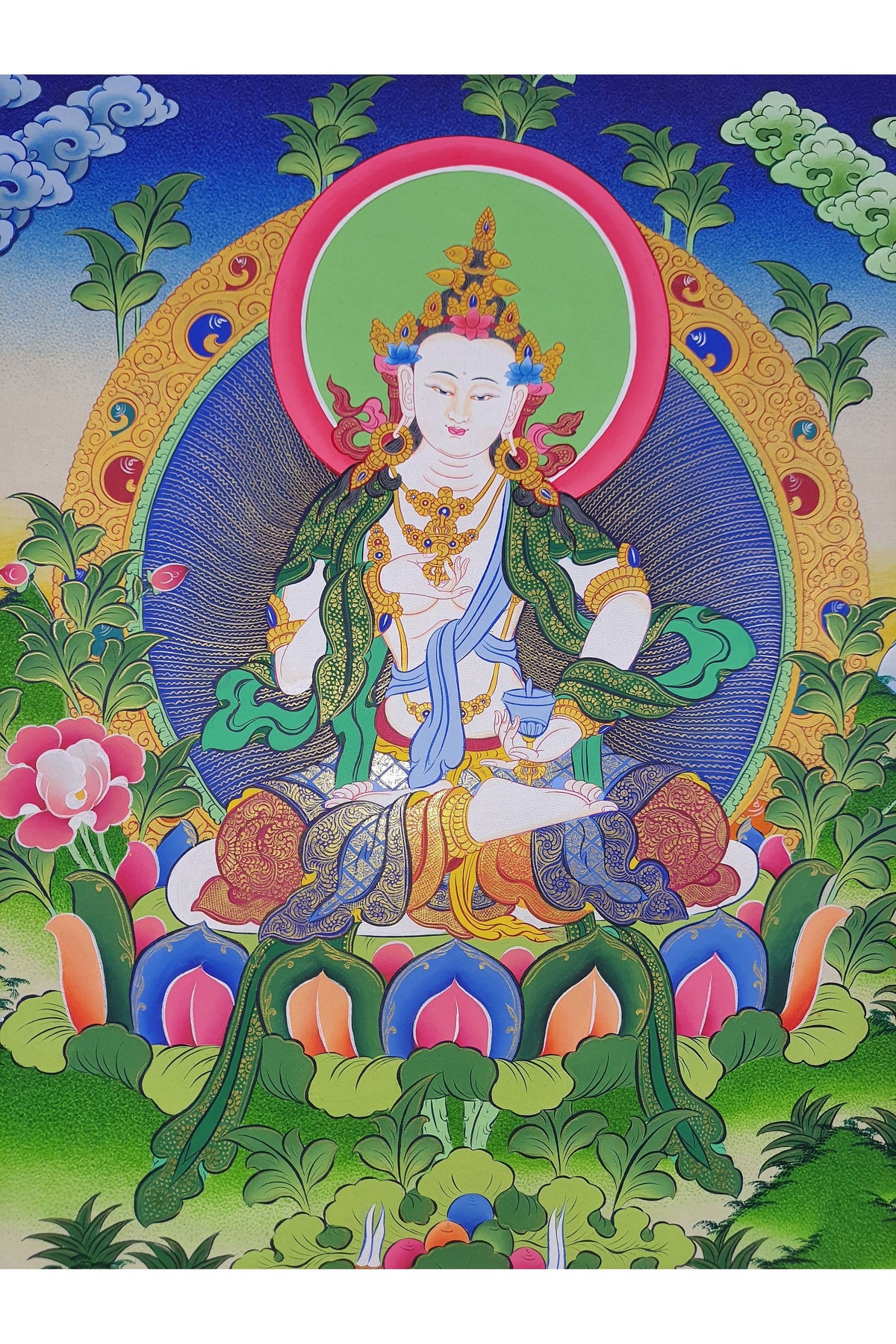
Hand-Painted Vajrasattva Thangka – Gold Tibetan Meditation Art
Hand-Painted Vajrasattva Thangka – Gold Tibetan Meditation Art
Impossible de charger la disponibilité du service de retrait
Vajrasattva is a Buddhist deity or Bodhisattva in Mahayana Buddhism and Vajrayana Buddhism. The name Vajrasattva means "Diamond Being" or simply "Thunderbolt Being", and in other words, the vajra is closely related to tantric Buddhism, often called the Tantric Buddhist Being. This Buddhist deity is mainly mentioned in two of the most popular sutras: the Mahavairocana Sutra and the Vajrasekhara Sutra.
As mentioned in the first chapter of the Mahavairocana Sutra, the people were very enthusiastic about learning the Dharma from Vairocana Buddha. The Vajrasattva led these people. At the moment, Vajrasattva inquires about the cause, goal, and foundation of all-embracing wisdom, thereby leading to a philosophical discourse by the Vairocana Buddha. During the discourse, the people weren't able to comprehend the teaching, so the Buddha demonstrated the use of the mandala. Another question that Vajrasattva asked was why rituals and objects are needed if the truth is beyond form. In reply, Vairocana Buddha stated that these are expedient means to facilitate practitioners' experience of awakening more readily.
Vajrasattva is a central icon in Newar Buddhism, followed by the Vajracharya of the Kathmandu Valley. Vajrasattva represents the ideal guru and is frequently invoked in the guru mandala, the foundational ritual for all other Newar Buddhist rituals, as well as the daily puja for Newar priests.
Shingon Buddhism
In this section. In Buddhism, Vajrasattva is traditionally viewed as the second patriarch. According to Kukai's writings in the Record of the Dharma Transmission, he recounts a story based on Amoghavajra's account, in which Nagarjuna met Vajrasattva in an iron tower in southern India. As mentioned in the Mahavairocana Sutra, Vajrasattva initiated Nagarjuna into the abhiseka ritual and entrusted him with the esoteric teachings he had learned from Vairocana Buddha.
Tibetan Buddhism
In Tibetan Buddhism, the Vajrasattva root tantra is known as Dorje Gyan, or Vajra Ornament. Vajrasattva practices are standard to all four schools of Tibetan Buddhism. They are used both to purify obscurations, allowing the Vajrayana student to progress beyond Ngondro practices to the various yoga practices of tantra, and also to purify any broken Samaya vows after initiation. Therefore, it is believed that the Vajrasattva practice is a crucial component of Tibetan Buddhist practice. The Vajrasattva practice is not only bound to personal practice, but it is also regarded as having the ability to purify karma, bring peace, and cause enlightened activity in general.
Size 16 x 23 Inches ( 41 x 58 cms)
Surface material: HANDMADE COTTON CANVAS
COLOR: NATURAL STONE/GOLD/WATER
Before making a purchase, please take note of the following important information:
- Each painting is hand-painted, making every piece unique.
- Differences in lighting and screen resolution may result in slight color variations.
- Paintings are even more captivating when viewed in person.
- The size specified for the painting does not include the outer border.
- All paintings will be securely packed in a PVC tube to ensure safe transit.
- Buyers are responsible for any additional fees at their destination, including import taxes and duties, which are not included in the purchase price.
Thank you for choosing us for your artwork needs.
Partager