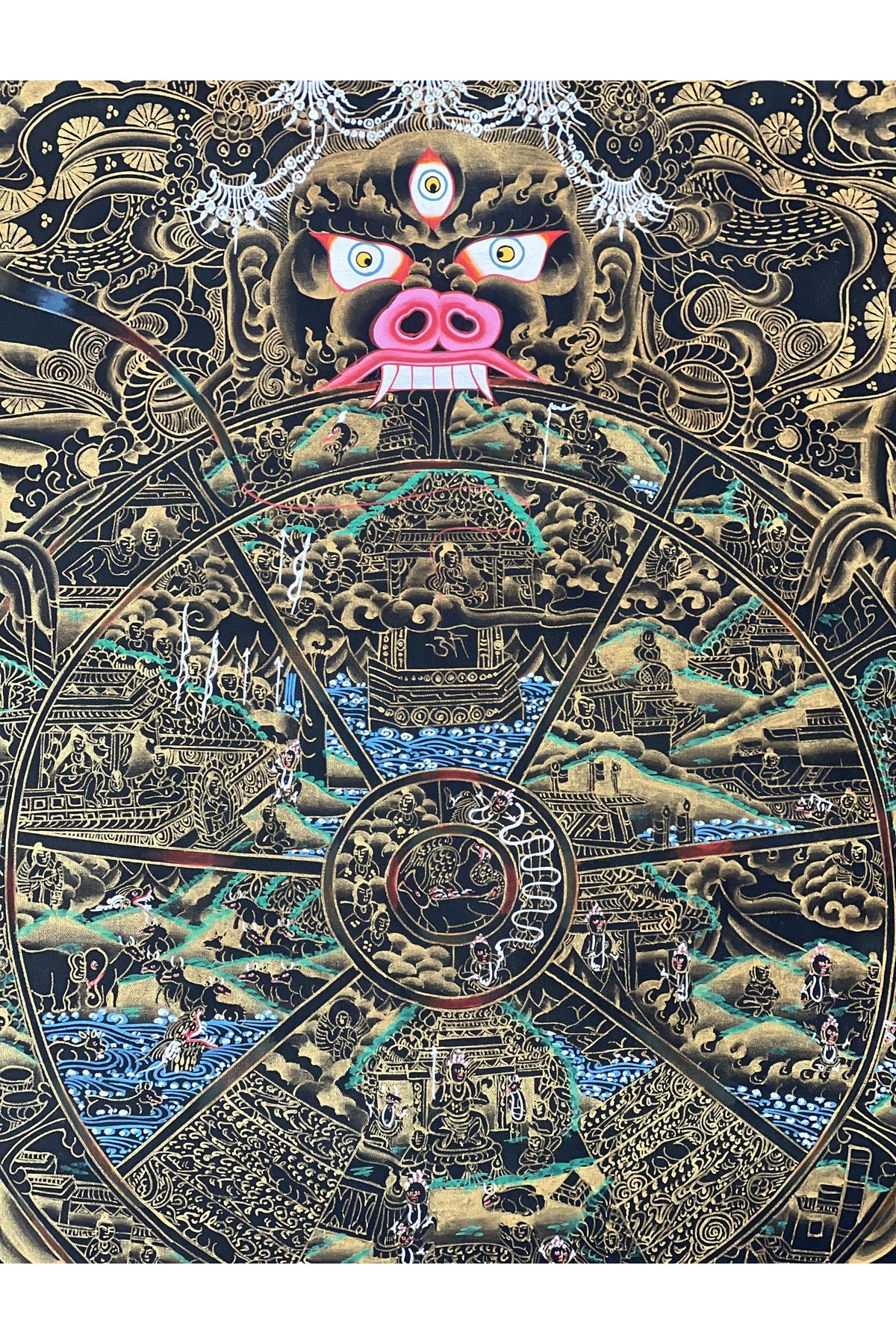
Hand-Painted Wheel of Life Thangka, Black and Gold Mandala Art (18x24-Inch)
Hand-Painted Wheel of Life Thangka, Black and Gold Mandala Art (18x24-Inch)
Impossible de charger la disponibilité du service de retrait
Original Hand Painted Wheel Of Life /Bhavacakra Mandala Large Masterpiece Tibetan Meditation compassion thangka/thanka painting
Size: 18 x 24 -Inch ( 46 x 61 cm)
Material: Handmade Cotton Canvas,
This is an original hand-painted Tibetan Thangka Painting of the Samsara/Wheel of Life Bhavacakra Mandala. It is painted in a Black and Gold theme, showcasing the artist's unwavering attention to detail and dedication. The Wheel of Life Mandala, a potent tool used by Buddhist monks to elucidate Buddha's teachings, is a testament to the depth and richness of this art form. It guides us towards realizing that liberation from the cycle of existence, known as Samsara, is possible and within our reach. Samsara is the continuous cycle of birth, life, death, and rebirth. The Wheel of Life is a metaphysical diagram of four concentric circles, held firmly in the center by Yama, the Lord of Death, as a poignant reminder of life's impermanence. The sky adorned with clouds or stars, located above the Wheel, represents the state of liberation from Samsara, which we can strive to attain.
In the center of the world, there are three animal symbols of the "Three Poisons": ignorance (the pig), attachment (the bird), and anger (the snake)—Buddhist Teaching. The snake and bird are shown coming out of the mouth of the pig, indicating that anger and attachment arise from ignorance. At the same time, the snake and the bird grasp the pig's tail, suggesting that they both promote even greater ignorance. Next to the central circle is the second layer, divided into two-half circles, one light-colored and the other usually dark.
These images represent thWheelel of Karma, the law of cause and effect. The darker portion shows individuals experiencing the results of adverse action. The light half circle, instead,
indicates people experiencing the results of positive actions and attaining spiritual ascension. Beyond this layer is a broader area divided into six parts, each depicting a different realm of Samsara. These six realms constitute all possible states of existence in the universe, and all beings cycle between these states. They can be divided into higher and lower realms.
The three higher realms are:
1 . The Human Realm
The human realm is the world of everyday experience. Human life, containing both pleasure and pain, makes us aware of these aspects of life. Buddhism teaches
such harmonious balance allows us to pursue spiritual realization, which is why the human world is considered the most suitable realm for practicing dharma.
2 . The Semi-Gods Realm
The titans who live in this realm are not content with what they possess. They spend their time fighting among themselves or making war with the gods. These semi-gods do not suffer from desire or greed but constant fighting and jealousy.
3 . The Realm of the Gods
These gods are pictured as beings not far from the human dimension. They share similar sensuous experiences. The god's entire life is full of abundance and pleasure. However, they spend their existence pursuing meaningless distractions and never thinking about practicing harm. Thidepleteste their good Kar, and they'll suffer through being reborn in the lower realms.
The three lower realms are:
4 . The Hell Realm
Hell is typically represented as a place of intense torment where beings endure unimaginable suffering. The Vic. s are subjected to the most terrible tortures inflicted by demons.
In the Buddhist tradition, there are eighteen "hells" that can be hot or cold.
5 . The Hungry Ghosts Realm
This realm is inhabited by pathetic creatures suffering from extreme and perpetual hunger and thirst.
They constantly wander in search of food and drink. However, even if they get what they want, it will cause them intense agony.
6 . The Animals Realm
In this realm, life is based on self-preservation. Animals live in constant fear and suffer from being attacked and eaten by other animal animals or refuse to see beyond their physical needs.
In some wheel of life representations, a Buddha or bodhisattva is depicted inside each realm, trying to help the living beings find their way to Nirvana. The outermost concentric ring of the Wheel of Life presents the process of cause and effect in detail. The circle is divided into twelve parts, each depicting a phase of the law of Karma, which keeps us trapped in the six realms of cyclic existence.
The twelve causal links and the correspondent allegories are:
Avidyā: Ignorance – a blind man, often walking.
Saṃskāra: Mental Formations – a potter shaping a vessel.
Vijñāna: Consciousness – a man or a monkey grasping a fruit
Nāmarūpa: Name and form – two men afloat in a boat
Ṣaḍāyatana: Six senses – a dwelling with six windows
Sparśa: Contact – two lovers kissing or entwined
Vedanā: Feeling – a man with an arrow in the eye
Tṛṣṇa: Craving – a drinker receiving a drink
Upādāna: Grasping – a man or a monkey picking fruit
Bhava: Existence – a couple engaged in intercourse or a standing reflective person
Jāti: Rebirth – a woman giving birth
Jarāmaraṇa: Aging and Death – a corpse being carried
Bhavacakra Thangka paintings usually contain an inscription on the bottom explaining the process that keeps us in Samsara and how to reverse that process according to
the teaching of the Buddha that said:
I have shown you the path that leads to liberation
But you should know that liberation depends upon yourself.
The Wheel of Life is also known as:
Wheel of becoming
Wheel of Cyclic Existence
Wheel of Existence
Wheel of rebirth
Wheel of Saṃsāra
Wheel of suffering
Wheel of transformation
A beautiful book we suggest for a more detailed analysis of the symbolism of the Bhavachakra is The Tibetan Wheel of Existence: An Introduction by Jacqueline Dunnington,
published and distributed by Tibet House U . A monograph on the famous Buddhist
icon with seventeen color plates illustrating this fundamental teaching device created by the Buddha.
Before making a purchase, please take note of the following important information:
- Each painting is hand-painted, making every piece unique.
- Differences in lighting and screen resolution may result in slight color variations.
- Paintings are even more captivating when viewed in person.
- The size specified for the painting does not include the outer border.
- All paintings will be securely packed in a PVC tube to ensure safe transit.
- Buyers are responsible for any additional fees at their destination, including import taxes and duties, which are not included in the purchase price.
Thank you for choosing us for your artwork needs.
Partager