1
/
de
10
Vajrakilaya Thangka Painting | Dorje Phurba Tibetan Buddhist Art | Nyingma Wrathful Deity Hand-Painted in Nepal
Vajrakilaya Thangka Painting | Dorje Phurba Tibetan Buddhist Art | Nyingma Wrathful Deity Hand-Painted in Nepal
Prix habituel
$399.99
Prix habituel
Prix promotionnel
$399.99
Prix unitaire
/
par
Frais d'expédition calculés à l'étape de paiement.
Impossible de charger la disponibilité du service de retrait
This original hand-painted Vajrakilaya Thangka is a master-quality work of Tibetan Vajrayana Buddhist art, distinguished by its intricate iconography, refined natural colors, gold detailing, and powerful composition.
Known in Tibetan as Dorje Phurba, Vajrakilaya is a major wrathful meditation deity, particularly important within the Nyingma tradition. His fierce appearance does not represent ordinary anger or violence. In Vajrayana iconography, wrathful forms express the uncompromising energy of enlightened wisdom directed toward overcoming ignorance, attachment, aversion, and obstacles on the spiritual path.
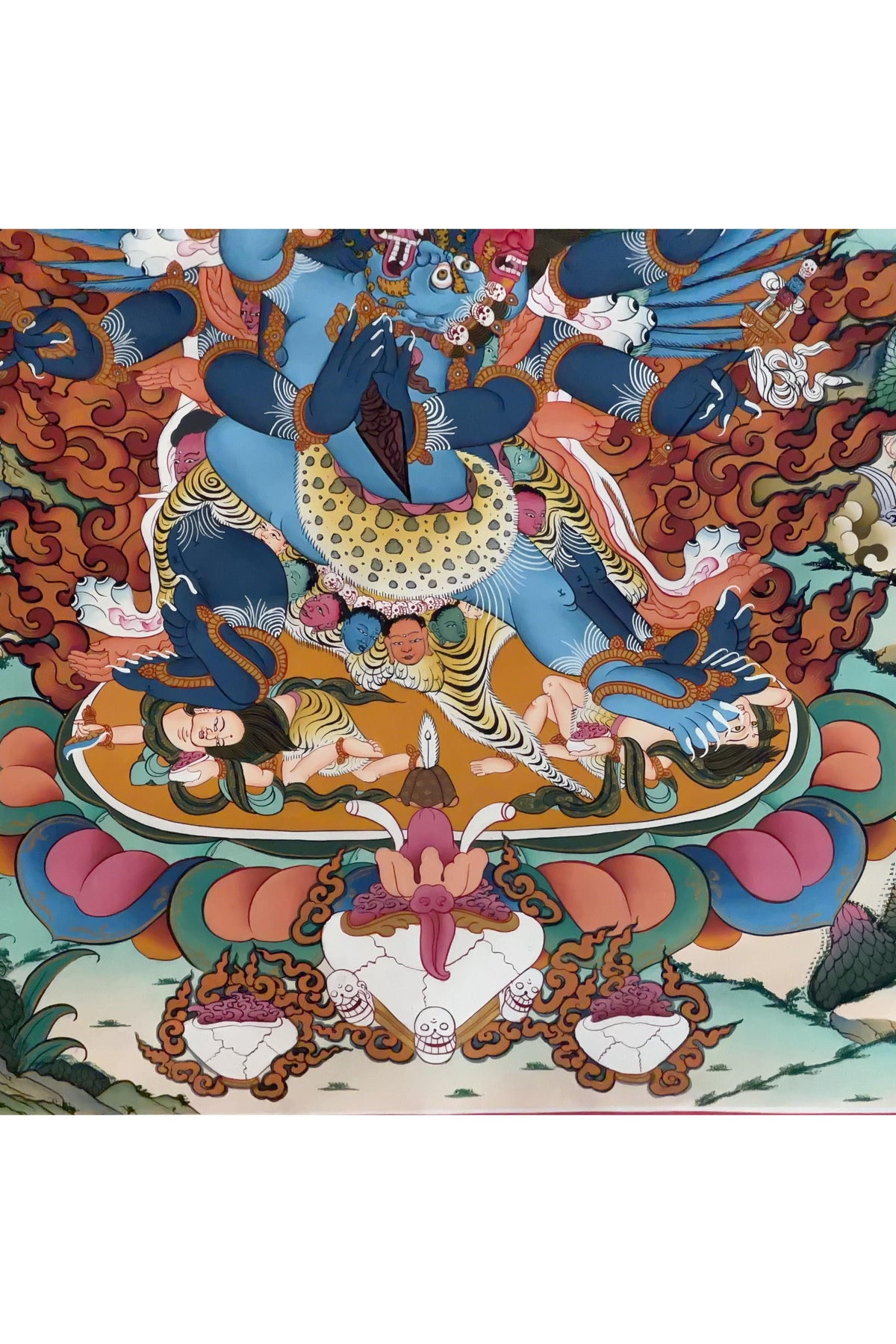
At the center of this composition, Vajrakilaya appears in union with his consort, surrounded by flames of wisdom and an extraordinary concentration of symbolic attributes. Every element, from the three faces and six arms to the ritual phurba dagger, animal skins, vajras, skull imagery, and blazing aureole, belongs to the sophisticated symbolic language of tantric Buddhist art.
Painted entirely by hand on handmade cotton canvas using stone pigments, gold, and traditional Tibetan hide glue, this is an original painting rather than a print or digital reproduction.
Vajrakilaya, the Wrathful Activity of Enlightenment
Vajrakilaya occupies an especially significant position in the Nyingma school of Tibetan Buddhism.
His practice is traditionally associated with removing obstacles and transforming forces that interfere with Dharma practice. Rather than understanding such obstacles only as external enemies, Vajrayana teachings also emphasize the internal obstacles created by ignorance, ego-clinging, attachment, aversion, and habitual patterns of mind.
This distinction is important when interpreting the deity‘s fierce appearance.
The flames, weapons, skull imagery, and dynamic posture visually express transformation. They represent enlightened activity confronting the causes of suffering without hesitation.
Vajrakilaya and Guru Padmasambhava
Vajrakilaya practice has a particularly important relationship with Guru Padmasambhava and the early transmission of Vajrayana Buddhism in Tibet.
Within the Nyingma tradition, Vajrakilaya teachings are closely connected with Padmasambhava and his disciples and became an important cycle of tantric practice associated with overcoming obstacles to Buddhist practice and activity.
For this reason, Vajrakilaya remains an important meditation deity within numerous Nyingma lineages.
The image is therefore not simply a representation of a wrathful protector. For practitioners, it belongs to a living contemplative tradition with a complex ritual and philosophical background.
The Phurba, Dagger of Transformative Wisdom
Vajrakilaya‘s most recognizable attribute is the phurba, the three-sided ritual dagger from which the deity derives his distinctive identity.
In this context, the phurba is not an ordinary weapon. Symbolically, it represents the penetrating power of wisdom and concentrated enlightened activity.
Its three-sided form is commonly interpreted in relation to the transformation of the Three Poisons: ignorance, attachment, and aversion.
These three mental afflictions are fundamental causes of suffering in Buddhist teaching. The ritual dagger therefore communicates the decisive transformation of the mental forces that bind beings to samsara.
This symbolism explains why Vajrakilaya imagery can appear extraordinarily fierce while its underlying purpose remains connected with awakening.
Three Faces, Six Arms and Four Legs
Vajrakilaya‘s complex physical form communicates multiple dimensions of enlightened activity simultaneously.
He is traditionally portrayed with three wrathful faces, six arms, and four legs. His principal hands hold the great phurba at the center of the composition, making the ritual dagger the deity‘s visual and symbolic focus.
Additional hands hold tantric implements, including vajras and other ritual attributes.
The vajra represents indestructibility and the unchanging nature of awakened wisdom. Other ritual objects reinforce themes of transformation, mastery over obstacles, and enlightened activity.
His dynamic stance communicates tremendous energy rather than meditative passivity.
Vajrakilaya and His Consort
Vajrakilaya appears in Yab Yum union with his wisdom consort, an important feature of advanced Vajrayana iconography.
The union should not be interpreted simply as an ordinary physical embrace. In tantric Buddhist art, male and female figures in union communicate the inseparability of complementary aspects of awakening, particularly skillful means and wisdom.
His consort carries her own tantric attributes, including skull imagery traditionally associated with transformation, impermanence, and transcending ordinary attachment.
Together, the figures visually express non-dual realization.
Wrathful Ornaments and Animal Skins
The elaborate wrathful imagery surrounding Vajrakilaya is intentionally confronting.
Animal skins, skull ornaments, severed-head imagery, ritual implements, and other fierce attributes symbolize the transformation or conquest of particular forms of delusion and ego-clinging.
Such imagery is characteristic of many wrathful Vajrayana deities. It should be read symbolically rather than as a celebration of literal violence.
The imagery asks the practitioner to confront precisely those aspects of mind that ordinary consciousness would prefer to avoid.
The Fire of Wisdom
A blazing aureole of flames traditionally surrounds Vajrakilaya and his consort.
These are not ordinary destructive flames. They represent the intense fire of primordial wisdom that consumes ignorance and obscurations.
The contrast between the fierce central figures and the carefully painted sky, moon, clouds, and softer background creates a compelling visual balance in this Thangka.
The restrained natural palette allows the complex iconography to remain dominant without making the overall painting visually overwhelming.
Master-Quality Himalayan Craftsmanship
This Vajrakilaya Thangka is painted entirely by hand on handmade cotton canvas.
The artist uses a traditional combination of natural stone pigments, gold, and Tibetan hide glue to create the painting. Fine brushwork is required to render the multiple faces, arms, ritual objects, ornaments, consort, flames, and numerous small symbolic details within the composition.
At 18 x 24 inches, the painting provides sufficient space for unusually fine iconographic detail while remaining practical for an altar, meditation room, or private collection.
The approximately 1.5-inch surrounding outer border is not included in the stated painting dimensions.
As an individually created artwork, slight variations in brushwork, natural pigment, line work, and surface characteristics are inherent to the traditional handmade process.
Product Details
Subject: Vajrakilaya
Tibetan Name: Dorje Phurba
Tradition: Tibetan Buddhism, Vajrayana
Primary Association: Nyingma Tradition
Form: Wrathful meditation deity with consort
Painting Size: 18 x 24 inches, 46 x 61 cm
Outer Border: Approximately 1.5 inches, excluded from painting dimensions
Surface: Handmade cotton canvas
Colors: Natural stone pigments and gold
Binding Medium: Traditional Tibetan hide glue
Technique: 100% hand-painted
Quality: Master Quality
Frame: Unframed
Origin: Nepal
Condition: Original hand-painted artwork, not a print
Suitable For
Nyingma and Vajrayana practitioners
Vajrakilaya and Dorje Phurba practice
Buddhist meditation and contemplation spaces
Dharma centers and retreat spaces
Traditional Buddhist shrines
Collectors of wrathful deity Thangkas
Collectors of Tibetan and Himalayan sacred art
Experienced collectors of Vajrayana iconography
Shipping and Important Information
We will carefully roll the painting and pack it securely in a protective PVC tube for safe international transport.
Actual colors may vary slightly because of photography, lighting conditions, and individual screen settings. Natural pigments, gold details, and fine brushwork often show greater depth when viewed in person.
The stated 18 x 24 inch measurement refers to the painting and excludes the approximately 1.5-inch surrounding border.
Because this is an individually hand-painted artwork, minor variations and irregularities in brushwork, pigment application, and surface texture are natural characteristics of traditional craftsmanship.
Please examine all listing photographs carefully, particularly close-up photographs of the deity, consort, ritual implements, and fine details, before purchasing.
Import duties, customs charges, VAT, and other destination-country taxes, where applicable, are the buyer‘s responsibility. Etsy may collect applicable VAT or sales tax directly during checkout for eligible destinations.
Partager