1
/
de
10
Yamantaka Vajrabhairava Thangka | Hand-Painted Tibetan Buddhist Art with Vajravetali | Master Quality Nepal
Yamantaka Vajrabhairava Thangka | Hand-Painted Tibetan Buddhist Art with Vajravetali | Master Quality Nepal
Prix habituel
$409.99
Prix habituel
Prix promotionnel
$409.99
Prix unitaire
/
par
Frais d'expédition calculés à l'étape de paiement.
Impossible de charger la disponibilité du service de retrait
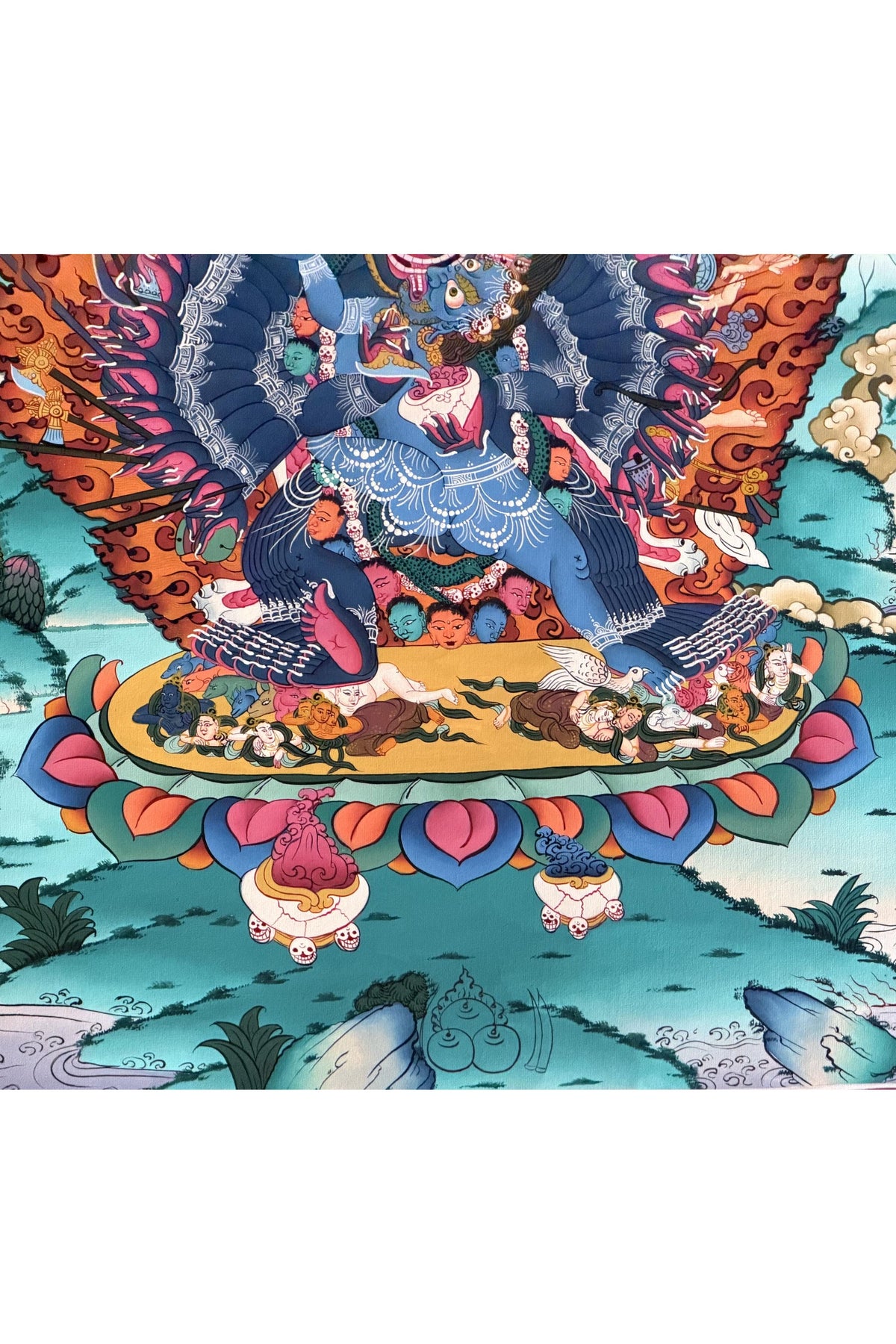
This original hand-painted Yamantaka Vajrabhairava Thangka is a master-quality work of Tibetan Vajrayana Buddhist art, portraying the formidable meditational deity in union with his wisdom consort Vajravetali.
Painted entirely by hand in Nepal on traditional cotton canvas, the composition is exceptionally complex. Yamantaka’s multiple faces, thirty-four arms, sixteen legs, numerous tantric implements, wrathful ornaments, surrounding flames, and embracing consort require extraordinary precision from the artist.
The artist uses gold pigment, traditional colors, and Tibetan hide glue to create a richly detailed painting measuring 18 x 24 inches.
Despite its fearsome appearance, Yamantaka does not represent evil or uncontrolled anger. His wrathful form expresses enlightened wisdom confronting ignorance, attachment, fear, and the forces that perpetuate samsaric suffering.
This is an original master-quality hand-painted Thangka, not a print or digital reproduction.
Yamantaka, the Destroyer of Death
The Sanskrit name Yamantaka can be understood as the Terminator or Conqueror of Yama, the Lord of Death.
This does not simply refer to defeating physical death. Within Buddhist philosophy, the deeper significance concerns overcoming ignorance and the conditions that perpetuate samsara, the recurring cycle of birth, death, and rebirth.
Yamantaka practice belongs to the advanced tantric traditions of Tibetan Buddhism and is particularly important within the Gelug school.
His extraordinarily fierce appearance represents the intensity of enlightened activity required to confront deeply rooted delusion.
Vajrabhairava, the Wrathful Form of Manjushri
In this form, Yamantaka is also known as Vajrabhairava.
One of the most significant aspects of his identity is his relationship with Manjushri, the Bodhisattva of Wisdom. Vajrabhairava is understood as a wrathful manifestation of Manjushri.
This contrast is one of the most fascinating in Tibetan Buddhist iconography.
Manjushri is generally portrayed as youthful, peaceful, and serene. Vajrabhairava appears enormous, terrifying, and surrounded by flames. Yet both ultimately express enlightened wisdom.
The distinction lies in the form through which that wisdom is communicated.
The Buffalo Head
The enormous buffalo head is one of Vajrabhairava’s most immediately recognizable characteristics.
Its connection with Yama, traditionally associated with the buffalo, reinforces Yamantaka’s identity as the conqueror of death.
Above and around the principal buffalo face appear additional faces, culminating in Manjushri‘s peaceful face. This peaceful presence within the otherwise wrathful composition reveals the deity‘s underlying nature.
Behind the terrifying exterior is awakened wisdom.
Thirty-Four Arms and Sixteen Legs
Vajrabhairava is among the most iconographically complex figures encountered in Tibetan Thangka painting.
He is traditionally represented with nine faces, thirty-four arms, and sixteen legs.
His many hands carry a remarkable variety of tantric implements and symbolic objects. Rather than functioning as decorative additions, these attributes communicate different aspects of enlightened activity and the transformation of obstacles.
The many limbs create the impression of activity extending simultaneously in every direction.
For the Thangka artist, this presents a significant technical challenge. Each arm, hand, implement, leg, face, ornament, and surrounding figure must remain visually distinct while still forming a balanced central composition.
Union with Vajravetali
Yamantaka appears in embrace with his consort Vajravetali.
This Yab Yum imagery has a specific tantric meaning and should not be interpreted simply as an ordinary physical or romantic embrace.
In Vajrayana iconography, the union of male and female figures represents the inseparability of complementary aspects of awakening, particularly method (skillful means) and wisdom.
Vajravetali therefore forms an integral part of the composition‘s philosophical meaning rather than functioning merely as an accompanying figure.
Their union expresses a state in which wisdom and enlightened activity are understood as inseparable.
Tantric Implements and Wrathful Symbols
The numerous objects held in Vajrabhairava‘s hands form an elaborate symbolic vocabulary.
His principal attributes include a curved ritual chopper and skull cup, while his remaining hands carry an extensive array of implements associated with tantric symbolism.
Skull ornaments, animal skins, weapons, flames, and other fierce imagery appear throughout the composition.
These elements can look disturbing when interpreted literally. Within Vajrayana art, however, wrathful imagery commonly represents the transformation of delusion, ego-clinging, attachment, aversion, and other obstacles to awakening.
The imagery is transformative rather than a celebration of violence.
Figures Beneath His Feet
The beings and figures beneath Yamantaka‘s sixteen feet add another layer of symbolism to the composition.
His forceful stance communicates mastery over obstacles, conditioned states, and forces that obstruct the path toward awakening.
The trampling imagery should therefore be understood within the symbolic vocabulary of tantric Buddhism rather than interpreted as an ordinary scene of physical conquest.
His entire posture communicates immovable enlightened activity.
Deep Blue Body and Wisdom Flames
Yamantaka‘s dark blue body gives the central figure tremendous visual intensity.
Blue in Vajrayana iconography can evoke the vast, unchanging character of awakened awareness. Against this powerful central form, the surrounding flames intensify the sense of movement and transformative energy.
The blazing wisdom fire traditionally associated with wrathful deities represents the burning away of ignorance and obscurations.
This contrast between the dark central figure, gold details, vivid ritual attributes, consort, and surrounding flames makes Yamantaka one of the most visually dramatic subjects in Tibetan Buddhist painting.
An Extraordinary Challenge for the Thangka Artist
An 18 x 24 inch Yamantaka painting demands considerably more miniature detail than many peaceful deity compositions.
Nine faces, thirty-four arms, sixteen legs, the consort, ritual implements, ornaments, surrounding beings, flames, and other symbolic elements must all be rendered within a carefully controlled iconographic structure.
The complexity makes fine line work and accurate proportions particularly important.
This painting is hand-painted on traditional cotton canvas using water-based colors, gold pigment, and Tibetan hide glue. The combination of detailed drawing, layered pigments, fine brushwork, and gold accents gives the original painting considerably more depth than a printed reproduction.
Because the artwork is individually handmade, slight differences in brushwork, pigment, line work, and surface characteristics are natural parts of traditional craftsmanship.
Product Details
Subject: Yamantaka with Vajravetali
Also Known As: Vajrabhairava
Tradition: Tibetan Buddhism, Vajrayana
Form: Wrathful meditational deity with wisdom consort
Painting Size: 17.7 x 23.6 inches, 45 x 60 cm
Size Note: Dimensions exclude the surrounding outer border
Surface: Traditional cotton canvas
Colors: Water-based colors and gold
Gold Detail: Gold pigment/gold powder
Binding Medium: Traditional Tibetan hide glue
Technique: 100% hand-painted
Quality: Master Quality
Frame: Unframed
Origin: Hand-painted in Nepal
Condition: Original artwork, not a print
Suitable For
Vajrayana Buddhist practitioners
Yamantaka and Vajrabhairava practice spaces
Buddhist shrines and meditation rooms
Dharma centers and retreat spaces
Collectors of Tibetan Buddhist art
Collectors of wrathful deity Thangkas
Collectors of complex Himalayan iconography
Experienced collectors of Vajrayana sacred art
Shipping and Important Information
The painting will be carefully rolled and securely packed inside a protective PVC tube for safe international transportation.
The stated 18 x 24 inch measurement refers to the painting itself and does not include the surrounding outer border.
Actual colors may vary slightly because of photography, lighting conditions, and individual screen settings. Gold details, natural pigments, and extremely fine brushwork generally show more depth when viewed directly.
Because this is an individually hand-painted artwork, subtle variations and minor irregularities in brushwork, pigment application, and surface texture are natural characteristics of traditional craftsmanship.
Please examine all listing photographs carefully, especially close-up photos of Yamantaka‘s face, hands, ritual implements, consort, and other fine iconographic details.
Import duties, customs charges, VAT, and other destination-country taxes, where applicable, are the buyer‘s responsibility. Etsy may collect applicable VAT or sales tax directly during checkout for eligible destinations.
Partager